
-1.svg "brillopak-automated-packing-machine-specialists- (2)-1")

For delicate products, the automation question is not whether or not a robot can pick them up – most modern robotic systems can handle items ranging from grapes to watermelons. The question is whether the full pick-and-place cycle keeps contact forces, acceleration and placement impact within the product’s tolerance. A punnet, tray, sleeve, bakery item or ready meal can easily be damaged by grip pressure, sudden movement, poor release angle or compression inside the pack. Gentle handling is therefore a measurable engineering problem, not a matter of visual judgement. In this article, we explore gentle robotic product handling and how to implement the best packing solution for pick and place fresh produce.

Automated Packing Without Product Damage
Why do delicate products get damaged during automated packing? Product damage usually occurs when the handling process applies more stress than the product or pack can absorb. That stress can come from direct contact pressure, rapid acceleration, vibration, impact at placement, or uneven support during transfer.
Pressure is especially important because it is not only the total force that matters, but how that force is distributed. A low force concentrated on a small area can mark, dent or deform a delicate pack more than a higher force spread evenly across a larger contact surface. This is why the design of the end effector matters as much as the robot itself.
Motion also affects product condition. A robot path that includes abrupt acceleration, sharp directional changes or poorly controlled deceleration can destabilise the product even if the initial pick is clean. For soft, flexible or loosely packed goods, excessive movement can cause internal shifting, seal stress or product displacement inside the packaging.
Improving Your Robotic Handling Processes Through Data Analysis
The question “will this damage my product?” should be answered with careful measurement and data analysis. For instance, when recommending a system for our customers, we often make use of instrumented test objects that record contact pressure and g-forces during the pick-and-place cycle, allowing engineers to see where stress occurs rather than relying on assumptions for industry benchmarks.
This data can be used to refine the handling process before your site commits to the final machine specification. If the readings show excessive force at the point of pick-up, the end effector can be redesigned or the vacuum profile adjusted. If the highest stress occurs during transfer, the robot path, acceleration curve or orientation can be modified. For if the risk appears at placement, the release height, angle or crate presentation may need changing.
This is the key distinction between a credible handling trial and a simple machine demonstration. A demonstration shows that the robot can move the product (which it will do 9 out of 10 times). A science-led trial shows how the product behaves during the movement in your specific operations.
Vacuum Handling For Pick And Place Fresh Produce
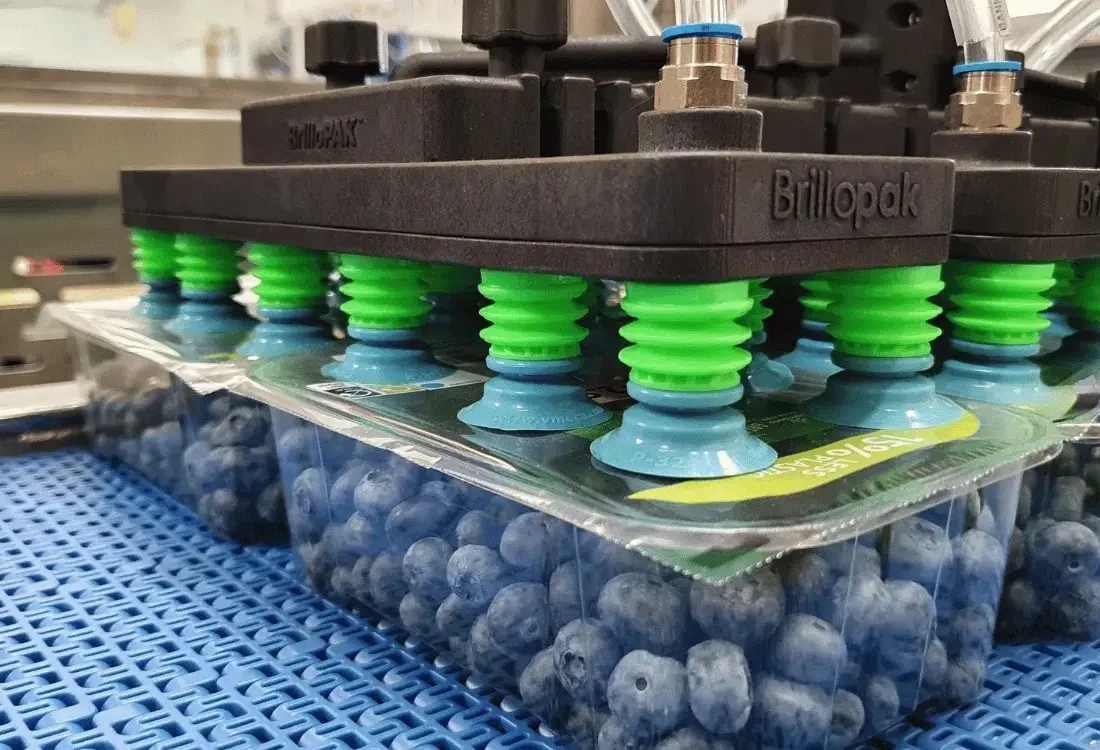
For many delicate packs, vacuum handling is effective because it can spread contact across selected areas rather than clamping the product mechanically. But vacuum still has to be engineered correctly. The cup size, cup position, suction level, surface seal and product rigidity all influence whether the pick is stable and whether the product is stressed.
Our end-effector design allows the handling head to be built around your product’s physical behaviour, creating enough grip, in the right places, with the least damaging contact pattern. Multiple independent vacuum generators can also improve control, so if one suction cup fails to seal because it lands over a vent hole, crease or uneven surface, the remaining cups can maintain the pick. That helps avoid compensating with excessive suction or mechanical pressure, both of which can increase damage risk.
Single-Pick Handling Reduces Accumulated Product Stress
Damage is not always caused by the robot touching the product too firmly. It can also occur when products are accumulated, compressed or stacked before placement. Single-pick handling reduces that risk by moving one item at a time and controlling its position throughout the cycle.
For tray-sealed punnets, soft fruit, sliced meat, bakery items and similar products, this can protect pack shape and presentation because the product is not forced into contact with other products before it reaches the crate or case. The right test is therefore not whether automation looks gentle. It is whether your product can be picked, accelerated, transferred, decelerated and placed within measured limits that protect product condition. That is where the science behind gentle handling becomes the basis for a reliable automation investment decision.
Find Out More
If you’d like to find out more about gentle robotic product handling and the benefits for your operation, please get in touch today to book a free product trial at our Brillopak Tonbridge facility.
For delicate products, the real automation question is not speed; it is whether the product can be handled safely, consistently and without damage. Our latest post looks at the testing and end-effector design behind gentle handling. Read the full article on the Brillopak blog today.
Maximising Efficiency: Minimal Machine Footprint In Production Spaces
Crate Destackers Contribute To Fruit Producer’s Productivity Increase
No Comments Yet
Let us know what you think